 Save to Pinterest
 There's something almost magical about watching twelve egg whites transform into clouds of meringue—I learned this the hard way on a sweltering summer afternoon when my mixer died halfway through and I had to whisk by hand for what felt like forever. Angel food cake taught me that sometimes the simplest ingredients create the most ethereal desserts, and that patience with a whisk is its own kind of meditation. My grandmother used to make this for church potlucks, and I spent years thinking it was some impossible culinary art before finally understanding it's really just about respecting the egg whites and trusting the process.
I made this for my sister's baby shower on a spring morning, and watching her face light up when she realized there was whipped cream involved made the whole careful folding worth it. The kitchen smelled like vanilla and hope, and somehow the cake stayed perfectly moist even sitting out for three hours while we talked and laughed. That's when I realized angel food cake isn't just dessert—it's a small gift you give people without really trying too hard.
Ingredients
- Cake flour (1 cup, sifted): This is non-negotiable—all-purpose flour makes the cake heavy and dense, while cake flour's lower protein content keeps it airy. Yes, you can fake it with cornstarch, but honestly, just buy the real thing.
- Granulated sugar (1½ cups, divided): The flour blend gets ¾ cup, and you add the rest slowly while beating the whites—this gradual incorporation is what gives you those glossy, stiff peaks.
- Fine salt (¼ teaspoon): A tiny pinch that somehow makes everything taste more like itself without tasting salty at all.
- Large egg whites (12, room temperature): Cold eggs won't whip properly, so pull them out and let them sit while you prep everything else—this step genuinely matters more than you'd think.
- Cream of tartar (1½ teaspoons): This stabilizes the whites and prevents them from breaking down, plus it helps you get those glossy peaks that look like something from a magazine.
- Pure vanilla extract (1 teaspoon): The backbone of the flavor—use real vanilla if you possibly can.
- Almond extract (½ teaspoon, optional): A secret whisper of flavor that makes people wonder what makes this cake taste so good.
Tired of Takeout? 🥡
Get 10 meals you can make faster than delivery arrives. Seriously.
One email. No spam. Unsubscribe anytime.
Instructions
- Start with a spotless pan:
- Preheat your oven to 350°F and make absolutely sure your tube pan is clean and dry—any grease or moisture will sabotage everything. This is the one non-negotiable rule that people always underestimate.
- Build your flour blend:
- Sift together cake flour, ¾ cup sugar, and salt, then sift the whole thing together two more times. Yes, three times total sounds ridiculous, but this aeration is what makes the cake light, so trust the process.
- Whip those whites into oblivion:
- Beat the egg whites on medium-high speed until they're foamy, add the cream of tartar, and keep going until soft peaks form—you should be able to lift the beaters and see little peaks that flop over. This takes longer than you think.
- Gradually add the remaining sugar:
- Sprinkle in the other ¾ cup sugar in small handfuls while continuing to beat, watching as the whites go from glossy soft peaks to stiff, shiny peaks that stand straight up. This transformation is honestly hypnotic to watch.
- Fold in the vanilla and almond:
- Add both extracts and fold gently a few times—you want them distributed but not beaten in, which takes a gentle hand.
- Fold in the flour mixture carefully:
- This is where your patience pays off: divide the flour mixture into three parts and sift each portion over the whites, folding gently with a spatula just until you don't see streaks of white or flour. Under-mixing is actually your friend here—over-mixing deflates all that beautiful air you just created.
- Pour and smooth:
- Spoon the batter into your ungreased tube pan, smooth the top gently with a spatula, then run a thin knife through it in a few places to break up any massive air pockets (but not so many that you deflate it). Think of it like a gentle massage, not surgery.
- Bake until golden:
- Bake for 35–40 minutes until the top is golden and the cake springs back immediately when you touch it lightly. The smell at this point is almost torturous.
- Invert immediately:
- The second it comes out of the oven, flip the pan upside down onto a bottle neck, wire rack, or even a tall glass—the cake cools upside down so it stays tall and doesn't collapse. This looks wrong but is completely right.
- Cool completely:
- Let it hang out upside down for 1–2 hours until it's completely cool—this is not a step you can rush.
- Release and serve:
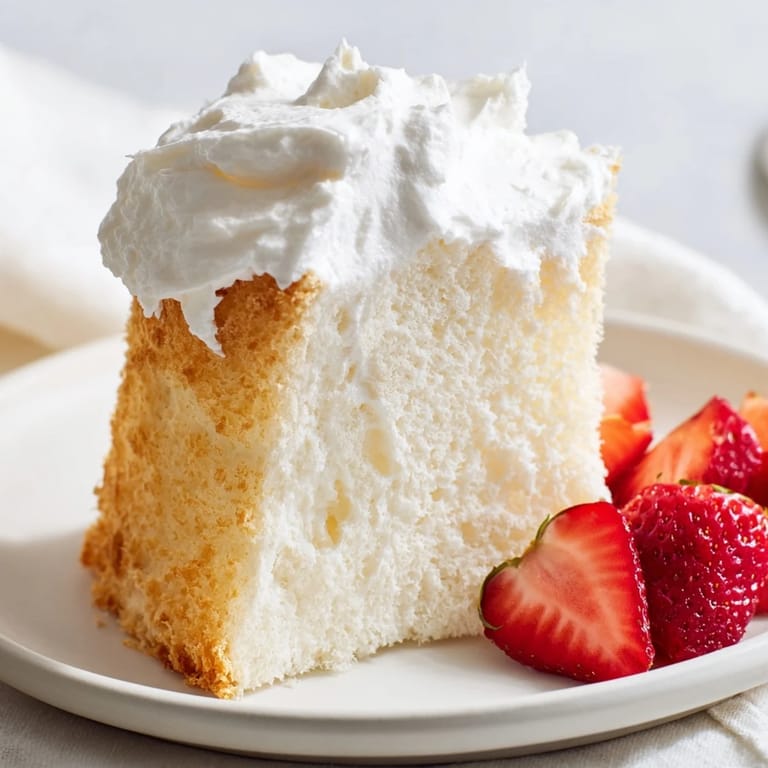
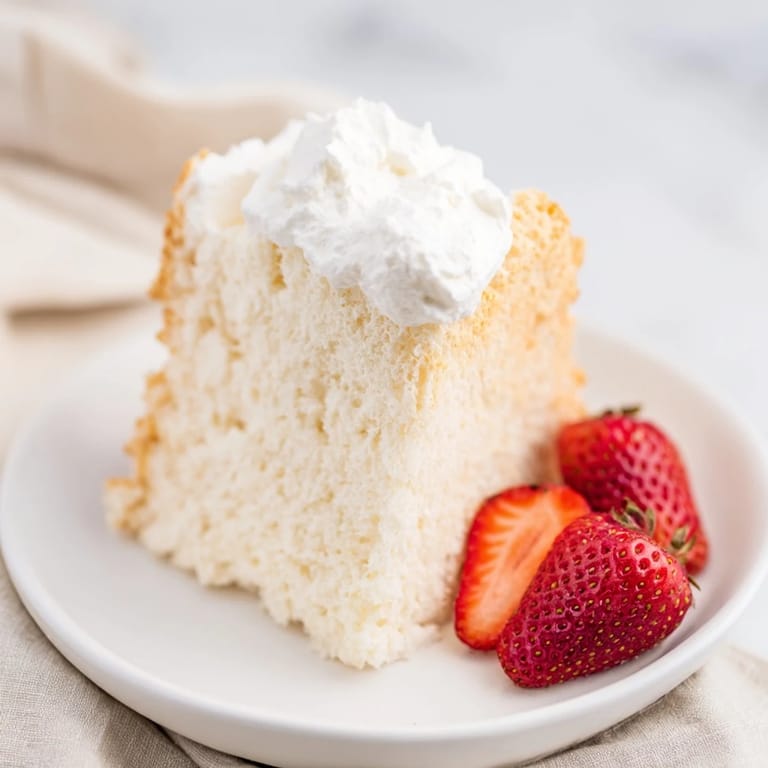
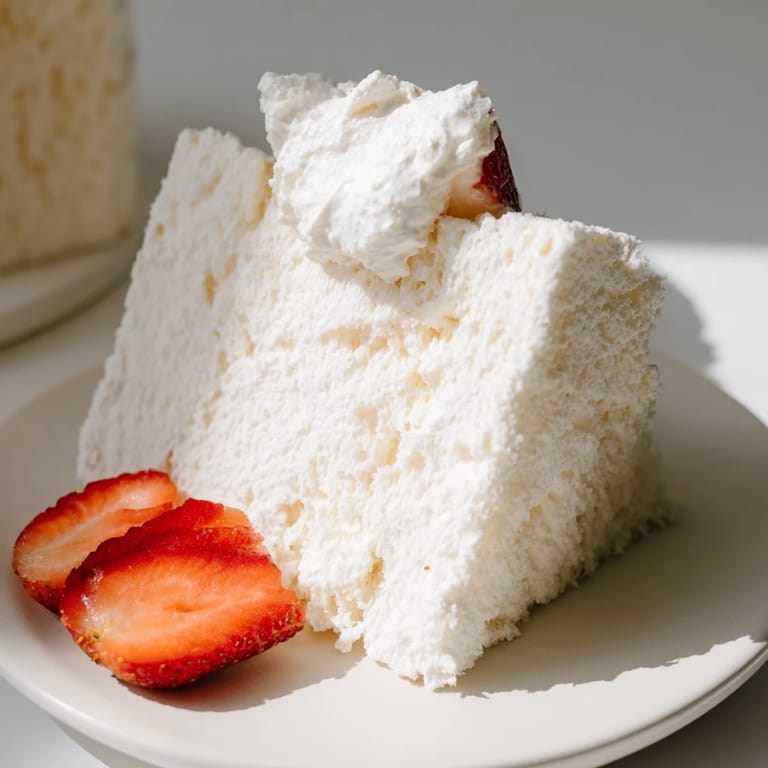
- Once cool, run a thin knife around the edges and the center tube, and the cake should slide out like it's on skates. Serve plain or top with fresh berries and whipped cream.
 Save to Pinterest
 Years later, my nephew asked why his angel food cake fell flat while mine stayed tall, and I realized in that moment that so much of baking is just paying attention to the small things nobody talks about. The care you take with each fold, the way you listen for the mixer to change pitch, the respect you show to twelve humble egg whites—that's what separates a beautiful cake from a dense disappointment.
Why Room Temperature Matters
Cold egg whites simply won't whip to their full potential—they'll reach soft peaks and then plateau, leaving you with a less voluminous, less stable meringue. I learned this the annoying way by grabbing eggs straight from the fridge in winter, and the difference was stark enough to never make that mistake again. Room temperature whites beat faster, incorporate air more readily, and give you those glossy, stable peaks that hold up beautifully.
The Art of Folding
Folding is different from mixing—you're not trying to combine everything thoroughly, but rather to gently incorporate the flour while keeping as much air as possible. The technique is simple: cut down the middle with your spatula, sweep it along the bottom of the bowl, and fold it up and over, rotating the bowl as you go. One friend of mine got impatient and turned it into vigorous mixing, and her cake came out dense and sad—so really, folding is where the magic either survives or dies.
Serving and Storage
Angel food cake is best served the day it's made, when the crumb is lightest and the structure is most delicate. It keeps reasonably well in an airtight container for a few days, though it slowly becomes staler—which is why I always invite people over to help finish it off.
- Fresh berries and unsweetened whipped cream are the classic pairing that lets the cake shine.
- A light drizzle of berry coulis or a spoonful of lemon curd adds elegance without heaviness.
- Serve it chilled or at room temperature depending on your mood, but never store it in the refrigerator, which dries it out.
 Save to Pinterest
 Making angel food cake is less about following a recipe and more about learning to trust a process that seems too simple to actually work. Once you understand why each step matters, you'll find yourself reaching for this whenever you want to make something that tastes like air and refinement.
Recipe FAQ
- → What makes this cake light and airy?
The volume comes from beating egg whites to stiff peaks and carefully folding in sifted cake flour, creating a delicate structure that traps air during baking.
- → Can I use all-purpose flour instead of cake flour?
Yes, but to maintain the light texture, replace 2 tablespoons of all-purpose flour with 2 tablespoons of cornstarch to mimic cake flour's lower protein content.
- → Why is the pan ungreased?
Leaving the tube pan ungreased allows the batter to cling to the sides as it rises, providing necessary support during baking for height and texture.
- → How should the cake be cooled after baking?
Invert the pan onto a bottle or rack immediately after baking and let it cool completely upside down to prevent collapsing and preserve volume.
- → Are there any tips for beating the egg whites?
Use room-temperature egg whites free of yolk, beat on medium-high speed until stiff, glossy peaks form, adding cream of tartar to stabilize the foam.
- → What flavors can be added to enhance it?
Vanilla and optional almond extracts add subtle aroma, and lemon zest or fruit compotes can introduce fresh citrus or sweet notes.